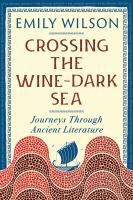
Crossing the Wine-Dark Sea by Emily Wilson is an erudite stroll through ancient literature, with a modern twist. Having done some minor translation of ancient work years ago, I thought I had at least a small understanding of what was involved in the world of translation. It turns out there is a great deal more to it than defining words and putting them in the proper order. It's really almost a science, and one that keeps evolving as years pass. There are significant contextual and cultural influences that need to be taken into account. This is why you can have books like Homer's Iliad and Odyssey that have been translated numerous times, and each time it's significantly different than the others.
The topic is certainly wider than just translation. It covers the cultural milieu that surrounded the classical world, and why those works still resonate with us today. The book primarily deals with the author's own battles with Homeric translation, but also discusses the work of other known translators. It also ventures outside the world of Homer and mentions several other Greek and Roman playwrights and poets. It's funny to think of these authors as having a rhythms and sound quality of their own, which seem to necessitate a reading that is both out loud and occasionally in some form of verse. Even if a translation into verse doesn't exactly match the meter of the original, it can at least provide some sense of flow that would likely have been the author's intention.
I will say here that I genuinely enjoyed reading this book from beginning to end. Looking at the list of chapters/essays, there were no weak points. This book will challenge you to engage with classics in a real and at times very human and visceral way. It will shake the foundations of what you thought you knew about the process and problems of translation, be it of an ancient or modern piece of literature. Moreover it will encourage you to reacquaint yourself with something that you hold near and dear, but that you may wish to reconsider because you read it as a translation. A translation, like say a book review, is something that has to be viewed through the lens of the author. And so this review, like a translation, can be a distortion of what is really on the page. The best thing you can do is engage with the original as much as possible. Read the book, and make your own judgments!